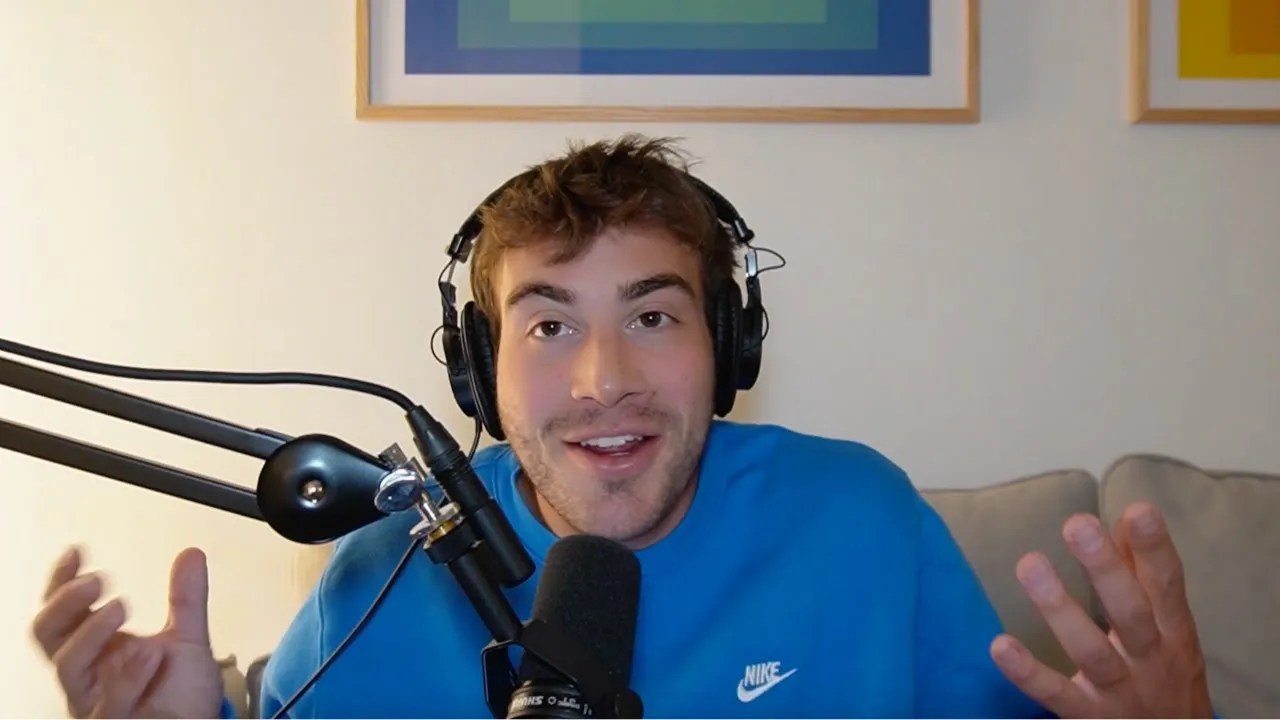
Why Am I So Nervous To Ask Someone Out In Person?
TRANSCRIPT
I learned a staggering statistic last week. Are you ready for this staggering statistic I have for you? I learned that 49 % of guys ages 18 to 25 have never asked a girl out in person. Almost 50 % of guys from the freshman year of college to three or four years out of college
have never asked a girl out in person. Isn't that kind of crazy? Isn't that a staggering statistic? Aren't you kind of like, whoa, really? Huh? And that could be for a multitude of reasons. And that's not to say that that 50 % of guys have never asked a girl out or have never asked somebody out in general. That clump of guys in that demographic or that age demographic maybe have asked somebody out, but not in person.
So that is saying that the art of asking somebody out is dying. There's a trend of that not happening amongst this generation, amongst guys in that age range, in my age range right now, I'm 25 years old. So that's kind of crazy to me. And that is for many reasons. And if you're not in that class of the 49 % who have or in that group of people, that's not a bad thing. That's not to say that's a bad thing or that.
you should be shamed for that because there's enough shame around that as is and I'm going to talk about why I think this is what like when I heard that at first I was kind of like whoa really and then I was like yeah I mean absolutely that makes sense because there's
So much shame around not asking people out in person and not feeling confident enough to ask people out in person because it's an incredibly nerve-wracking thing to do. It is nerve-wracking as fuck to have to walk up to somebody and introduce yourself and say a line or try and flirt or try and give a compliment or say something that you think they're gonna like and put yourself out there. That is incredibly nerve-wracking. That is not an easy thing to do.
And there is a big shame around the fact that guys are not good at it, that you're not good at it internally and externally. There's a shame you have yourself that you're not good at it. And especially if you've never done it, especially if you're in the 50 % group that has never done it, that shame only grows and gets worse.
the longer it lasts because that voice in your head that tells you that you can't do it, that you've never done it, that you see all your friends doing it, but like, why can't you do it? Why are you a loser? Why are you a pussy? Like all of those things that are in your head telling you like you have an idea you're not good enough, blah, blah. That just gets bigger and louder and stronger the longer it lasts and the longer it continues. And that shame just builds and builds and builds, which is the same for
anything, right? Like the longer you give credence to it and make it a bigger deal, the bigger it becomes. And that's only the internal sides. That's just the one half of the having to think about walking up to somebody and introducing yourself. Now for the external side of shame, there's of course a fear of rejection that I have, that we all have, that holds us back from trying or walking up or doing that thing.
We're nervous or scared that going up to somebody to ask them out will leave us feeling rejected or leave us actually rejected and land us feeling pretty terribly about ourselves. And it will leave you and lead you to believe the things that you already thought about yourself internally, that you're unlovable, that you're not good enough, that there's nobody out there for you, that you're not, that like, I knew I wasn't good enough at doing this, I knew I should have done this, like why did I do that? Why did I make a fool of myself when I knew?
I shouldn't have in the first place. So now that I did it and I proved that to myself, like I've shown myself the things I thought about myself were true. So those are the two sides of this. It's internal and it's external. And rather doing anything about it, we kind of fall deeper and deeper into that shame hole around the fact that we're not good at it so we don't do it. And
Maybe it's nervousness around the fact that we're gonna leave a lasting, terrible impression on somebody, or they're gonna be like, wow, that guy was kinda weird, or that guy was a loser, or that line was weird that he said, why did he do that? Like, why did he say that? Blah, blah, blah, blah. Maybe we're worried that we're gonna make a fool of ourselves, or look like an idiot, or look like a loser. Maybe we're worried that we're gonna make somebody uncomfortable with our presence, that walking up to this girl is gonna make her feel uncomfortable, that she's not gonna want this, that she didn't want this in the first place, and that's another part of it too.
There are all these different things that we can think about as possibilities of things that might happen, of things that could happen if we do walk up, if we do introduce ourselves, if we do go flirt. And I know this because I've had first-hand experience at it. I know this because I've been there. And I've been on the battlefield that we call a bar or a club or any of the places that you go to introduce yourselves, a party, a housewarming party.
I'm just thinking of all the places that we're at when there's like a time and a place to introduce yourself or walk up to somebody I think those are like that kind of covers the battlefields the playing grounds if I may like a house party housewarming I don't know why I how some of the house party like an apartment like somebody's Friends house, whatever. I'm just now I'm just naming random shit like a dinner like a bar a club like all the places where you can go to introduce yourself I've been there and I've been through it and I've experienced
the anxiety and the fear and the doubt that can creep in and be so much louder than anything that's actually realistic. And this time of the year specifically from December until I don't know, let's call it the end of February has been coined cuffing season by our generation, by maybe the generation above us and it's trickled down into us.
which is the time of year when people want to get cuffed up or they want to be in a relationship. They want to have somebody to cozy up with in the winter and hibernate with. I don't know if it's in the wind or in the air, but if you look around, the chances are that there's a wavelength that a lot of people are on right now that they're trying to hook up with somebody or trying to meet somebody, whether you're on hinge, whether it's in person, like maybe...
you're noticing that people are trying a little bit harder than they do throughout the rest of the year. Maybe like this is the time that people are actually kind of not ignoring. They're actually trying to make it happen. And if you look around and you feel like you're behind or you're missing out and you want that too, but you don't know how to get there. That you're in that 50 % of the people that haven't done it yet and you don't know how to jump into the other side. You don't know how to join that other group.
I am gonna give you a mindset that I've adopted, that I've put on like a hoodie, that I think you might like too, that I am offering to you. Take it, borrow it, wear it, whatever you wanna do with it. I think this will really help you. So if you're in that group right now, don't worry. You won't be there forever and you don't have to be there forever. That voice doesn't have to get louder and stronger. It actually can go away, it can disappear. You can say fuck off to that thing.
and try on a different sweatshirt and try on a different hoodie and put on a new persona and try this new confidence that I'm gonna share with you, this new mindset that I'm gonna share with you. Now I'm not here to tell you like, fuck it, like go for it, like go walk up to her, like why do you have to lose? I'm not here to tell you that. And I'm not gonna say to you like, the worst that happened is you get rejected and then you're, and then like what you're just in the same spot that you were in before.
and like, bleh, like it's fine, like you're gonna be totally fine, just go fuck it, go do it, like bleh, no, I'm not gonna do that. you know, I think the reason that so many of us don't walk up to somebody is the fear of rejection and the perpetuated rhetoric that nothing happens if you get rejected. If you're get rejected, like it's gonna be fine, you're gonna be fine, like just go do it, just go try, like what do have to lose? That's not really the case. Like the manly ideal that
So what if you get rejected? Okay, like you're gonna be so fine. Like what's the worst that happens is so fucking tired and is so annoying as somebody who has personally been through it, goes through it. Like it is not an understandable or relatable sentiment to be like, it's so fine. Just go do it. Like what do you have to lose? That's not really the way it feels when you're in it.
And that might be the moment right before you do it because a lot of the time you do have to convince yourself to go do it. You do have to like let it all go, let it all fall away in order to convince yourself that you're confident enough to walk up. So maybe there is a split second or a moment or so where you do have to believe that you do have to hype yourself up. And I'll talk about that a little bit more in a little bit. But.
The mindset of it's all gonna be fine, like just go try is not really fair and is not one that I love so much and it's not really the case because it does hit your ego to be rejected. It does suck to get rejected. It blows and I know that because obviously I've been there before and it absolutely can ruin your night.
And it doesn't have to, but it does a lot of the time. It sucks and it makes you feel really shitty about yourself. And it hurts and you feel like kind of a loser for it. So I'm not here to be like, shoot your shot, King. Like, no. And I have said shit like that before. Like I have come on here and been like, so what if you get rejected? Like nothing matters. It's all fine. It's all good.
And a lot of the time, I think that was me trying to convince myself too of that. Like I think that was me trying to be like, yeah, like I'm going to try and like trying to hype myself up at the same time. And that was the mindset I had. And I think that works for some. And I want to offer another prescription to that, another like kind of antidote to it. And the truth is you do have to try to know.
You do have to put yourself out there to get the things you want or the things you desire or the things you think you want. You do have to put yourself out there to change your life. It's just not as easy as it sounds and it sure as shit is not helpful to be like, go shoot your shot, King. Like, what do you have to lose? Like, go out there and do it. Like that is just so not helpful. And I'm no expert in all of this, but I have been in the field with you and I do understand
what it feels like to be in the place where you're like, should I go do it? I don't know if I should do it, but I really want to do it. And then you convince yourself out of it and you psych yourself out of it. And then you go home and you're like, fuck, I wish I did that. Why didn't I do that? Like, I'm never going to see that person again. Like, why didn't I go say hi to her? Like she was cute and I'm never going to see her again. And I blew a chance that I had that I now will never have again. And you spin and you look at the ceiling and you're like, God damn it. Why didn't I do that?
I have been there and obviously from what I'm saying, you know, I've been there and I'm sure you've been there too. Chances are if you're a guy, 18 to 25 chances are if you're a guy in general, you've been in that scenario. If not last week, the month before last year, next week, then two weeks. Like that is an all too relatable scenario of after
this event or this thing, you're regretting not saying the thing to the person that you never got to say. You're regretting psyching yourself out. You're regretting the outcome that never got to happen. You're regretting the things you thought might happen or could happen, but now you never have the chance to see if they'll happen because you never gave your chance to let it play out. And I think one of the coolest parts about doing this podcast and for doing it
and doing it for as long as I've done it for so far, for about almost three years, which is so crazy, is that I have definitely been the perpetrator of that same rhetoric of like, go do it, like, what do you have to lose, life's short, there's nothing to lose. And that, I think, still stands true at the time I said it. And I think in that context, it might have been perfectly said and it might have been
It's there for a reason. But as my perspective changes and evolves and I develop, I get new perspectives and I have new things to say and I have new experiences to share with you that shape what I can bring on here and shape the advice that I have for you and that I have for myself too. And I learn new things, which I think is one of the coolest parts of our 20s too. Like a perspective that we hold so strongly
can shift pretty quickly when we learn something new, when we have a new experience that we give ourselves or that we let ourselves have that evolves us, that changes us. And all of sudden the things we believe so strongly is an entirely different thing we now believe pretty strongly. So instead of giving you some phrase that could live on a pillow on your bed or you see on a mood board on Instagram, like shoot your shot or like go do it or like what do you have to lose? Like you'll just be in the same spot that you were in before.
I'm gonna give you some prescriptive ideas to this percentage. I'm gonna give you some of the advice I think I have learned or the perspective that I've evolved about being nervous to walk up to somebody and saying hi. About getting out of that 51 % and moving yourself over to the percentage of guys that do go up and say hi because chances are if you're in that 51 % you probably want
to earth 49 whatever sorry chances are if you're in that 49 % you probably want to be in the 51 chances are you do not want to stay there and you're looking for a way out of that you're looking for a antidote a way a prescription a advice a perspective and I think I have that for you so buckle up I mean don't buckle up like you're just you've been here already for like 20 minutes so this isn't backed by science
But it is backed by experience. I think one of the best ways to combat the fear of rejection is to reframe the fear into excitement. Now, you might be asking, Josh, what the fuck does that mean? The repetitive negative voice in your head is so loud, right? But what if you put something against that? What if you put a new voice that was louder back at it to combat it?
Think about it this way. The champion in the ring right now is Fear. Fear is the one raising his hands in the air after the fight. He has been the reigning champion for way too long. He's been in the ring, he's walking around like he fucking owns the place because he does, because he does. He's owned the ring for a pretty long time now. He's won every single fight.
You've sent in a lot of different emotions to fight him. You've sent him, so you've sent him so many different competitors into that ring and he has beat every single one. He hasn't just beat them. He has destroyed every single one and fear is the reigning champ. He's won, let's just call it the past 50 fights in a row and no one has come close to him. At this point,
The audience has dwindled down because the fights are getting boring now. Like at first it was like, shit, there's a fight. there's round one, there's round two, there's round three, there's a ring girl, there's a sign. Like there's an announcer, there's announcers, there's entertainment. Like there's a fire show, like, you know, there's popcorn, soda. Like the audience is into it. Now it's fucking boring. It's repetitive. Like he wins every single time. There's nobody that's given coming close to him and we're bored. So the audience is dwindling. They're leaving.
Every fight now is just a quick first round knockout. Like, this shit's boring. Like, we've seen this film before. We're over this. No one seems to even stand a chance. Even the announcers are bored. Like, they're announcing it something like this. Like, they're like, And in this corner, way too much is fear. And in this corner, here's trying. Trying is here for the 15th time, weighing in at 11 pounds.
This is a featherweight vs. heavyweight fight and ding ding let it begin. And the pretty girl walks across the stage with the round one sign and she's not even smiling because she knows what the outcome is going to be. She knows because she's seen this many times before she's over it. She's holding the sign and she's yawning. She's like, hmm, round one, ding ding ding. The bell rings and so quickly.
Trying is knocked out within the first, let's call it, five seconds by fear. Trying didn't even stand a chance. Trying has been here 14 times before and he's exhausted. He keeps trying. Trying keeps trying. And he's not even coming close. He sits back up, he puts his shirt back. Here we go again. He's got a black eye, he's bruised, he's destroyed, he has no momentum, he has no motivation.
And yet again, he's here. He's like, what if I go again? Let's see what happens. Knocked out again. He's on the floor. And over time, fear has only gotten bigger and stronger. Fear's ego is so huge that it's almost a waste for trying to keep trying. But then all of a sudden, a new fighter comes onto the scene. The announcers see someone new from the corner of their eye. They say,
Wait a minute, who's that? They put their headsets back on and they're saying, ladies and gentlemen, boys and girls, we have a new fighter, something we've never seen before. And the crowd starts trickling back in. They say, hold on, do you hear that? The husband says, do you hear that? There's a new fighter in town. What do you mean there's a new fighter in town? We seen a new fighter in 15 years.
What do mean there's a new fighter in town? The crowd starts flooding back into the arena with their sodas and the popcorn. People are talking over and you overhear someone say, this guy's new. I like this new guy. I'm rooting for him. $500 on the new guy. Then you hear someone else say, I've heard he's really got a chance. He's been practicing. He's really, he looks like he's pretty good. I think he's gonna give fear a fight. I think he's gonna give fear a run for his money.
And then you hear a big buff guy say, need something here because this guy fear is really starting to piss me off. And if someone doesn't get in this arena, I'm gonna get in there and fight him myself. And his wife's like, yeah, sure, you're gonna fight him. And he's like, shut up.
And the lights go down over the arena. The time has come for the new fighter to face fear. And fear starts to put his hands down. He's like, wait a minute. Who's this new guy? Who's this guy? And from the corner, sparklers go up and the announcer goes, in this corner, a first time fighter. Everybody clap your hands and stomp your feet for the first time. Give it up.
For potential! And everyone's like, yeah, fuck yeah, holy shit, it's potential! my god! They'd never heard of him before, they're potential, what, let's go! Potential, potential, potential! Everyone's fucking freaking out, everyone's on their, everyone's on their feet, people are screaming, people are losing their goddamn-
Mines for potential people are buying shirts that say potential people there's six guys who are spelled POT and there's a seven guys who have potential written out across their test chests POT en wait e n t I a L put on trial everyone's freaking out losing their minds the crowd is going crazy Potential runs into the arena rising up
Back on the street took my time took my chance and everyone's like I think he's got this The pretty girl walks across with the round one sign. She's got a huge smile plastered across her face She's rooting for potential she looks back. She gives a wink. She says call me after the fight. He's like, I'll call you She's like if you survive this we're gonna get married. He's like, I'm so fucking lonely So she walks across the stage round one the crowd goes silent
Ding ding ding fear potential at each other. Everyone's like, fuck what's gonna
Fear throws the first punch, lands it, hits potential square in the jaw. Potential flies back. Everyone's like, no, you've got to be kidding me. Like I got all excited. I've been rooting for trying for years and we got all excited. We haven't had a fighter in so long that we're excited about trying sucks at this point. And it's not looking great. But potential doesn't give up that easily. Don't give up on potential. He gets back up, throws the next punch, hits fear.
It's the first time a punch has landed on fear. A punch has landed against fear in a long, long time. Everyone loses their minds. Skip forward to the end of the fight. It's round 10. Fear knocks out potential. I don't know. didn't have an ending to that, but I'm just gonna, I'm gonna end it with a fear knocks out potential. Everyone loses their goddamn minds. We have a new Victor potential.
All that to say
What if you got excited about the potential? What if you shifted the mindset from trying to excitement about your potential or about the potential?
What if you reframed the fear into excitement? What if it goes well? What if you thought to yourself instead of all of the things that could happen that might happen, the things that are going to make me feel embarrassed, nervous, like a loser, like an idiot, what if it goes well?
What if you tell yourself and remind yourself of all of the good potential outcomes instead of living in all of the negative ones? What if it works out?
Instead of me giving you all of the corny
Go do it, what do you have to lose if you do lose your back in the same spot you were again before? Like, even though all of that is true, that doesn't really work all the time. That doesn't make you feel like, you know what, I got this. But what if it worked out? What if you got excited about the potential of it working out? And that was enough to bring you from your seat to your feet. Like, what if you told yourself the story of potential?
instead of the story of trying. The reason my fighters were trying and potential were because they are completely different things. Trying doesn't always mean trying. Like, sometimes the effort you put in when you're trying isn't really trying. And you know that, and I know that. When you're like, I'm trying, I've been trying, and it's not working. That's not always trying at the best of your ability. That's not always...
your best effort or your best foot forward. Trying at times can feel draggy and dragged on. Trying can feel stressful. Above all, trying can feel incredibly frustrating, especially when it doesn't work out. It can feel grueling. It can make you feel strained. If you've been trying for a long time,
at anything and it's not working and it's not clicking, then you know what I mean about trying. It can feel all of those ways. But potential, that's completely different. Potential inherently comes with excitement and inspiration and imagination and optimism and promise. Potential invites new and evolution.
It's what might be or what could be. It's fresh. It's new. It makes you stand up a little taller and feel a little bigger and a little prouder. It's opportunity wrapped up in a different way. If you're nervous, try getting excited about the potential of what could happen instead of stuck in the fear of what might happen.
That's it right there. What could happen versus what might happen. It's probability versus possibility. It's trying versus potential. Could is all of the negative things you attach to the trying or the fear. Might is all of the great or exciting things that you attach to potential. What if you started focusing
on what's possible while everybody else is stuck on what's probable. And that's how you walk up to the girl and say hi.
And that's how you put yourself in the other 50%. Just like that. And that's also how you increase your chances by a hundred percent. I think that's how that works. It's not easy, but there is a simple mindset shift and your confidence grows not instantly, but it will over time.
You can't always avoid the awkward or the embarrassing. You can't avoid the uncertainty of flirting or of human connection. But you can decide your mindset going into it. You can't avoid the uncertainty of flirting or human connection. But you can decide your excitement towards it. You can decide your presence in the room.
The cool part about this statistic is that if you're scared or nervous or anxious to go walk up to somebody and say hi, you're amongst 50 % of the other guys at the bar. Half of the other guys around you are also in their heads thinking about if they should, debating if they should or the outcome of what's going to happen if they do and if they get rejected and how they're going to feel after.
debating it, nervous, anxious, scared, fearful. Half the other guys around you are also feeling that way too. Just nobody talks about it. And that means that you're not alone in it. That means just because guys don't talk about it, it doesn't mean we're all not feeling that way too. And we're all kind of in it together in a funny way if you think about it like that. Like, next time you're at a bar or a party or a setting where you're
interacting with everybody, look around, half the other people there are also nervous and anxious and debating if they should. Half the other guys are also feeling the same way you're feeling. That should give you some sort of comfort in that feeling. And that also means that walking up and saying hi puts you in the other category, just like that.
Walking up and introducing yourself to somebody puts you in that other 50 % that easily. The one that gets out of their head and into their feet. The one that starts to develop their own sense of confidence. And maybe by doing that, you'll end up inspiring someone else when they see you and think, if they can do it, so can I. And just like that, you've become the person that you never thought you could be.
Just like that, in an instant, you become the person that you were looking at thinking, how can I do that?
That is the episode. Thank you so much listening to guys said a guy's guide to what should be talked about. I'm Josh. I'm 25 years old and I'm here every single week every single Tuesday answering the questions that guys are asking. If you have anything you want me to talk about that should be talked about for guys head over to guyset.com. There is an ask me anything form right there. GUI S E T dot com.
and I will be sure to talk about it. can watch this full episode on YouTube at guyset, G-U-I-S-E-T. You can find me on Instagram, on TikTok at guysetpodcast and at the guyset. You can find new blog posts every day on guyset.com on everything I talk about on here, extended. It's like an extension of the guyset universe just on the website. Thank you so much. Listen to guyset, a guy's guide to what should be talked about and I will see you guys next Tuesday. if you're celebrating Christmas, Merry Christmas, Hanukkah, happy Hanukkah, happy Kwanzaa.
Happy holidays to everybody and I will see you guys next Tuesday. See you guys.