How To Wrestle Your Inner Critic with Andre Hardy
Former NFL player and Tear the City Down author Andre Hardy on self-doubt, discipline, meditation, and learning to keep going when your own mind gets in the way.
By
Josh Felgoise
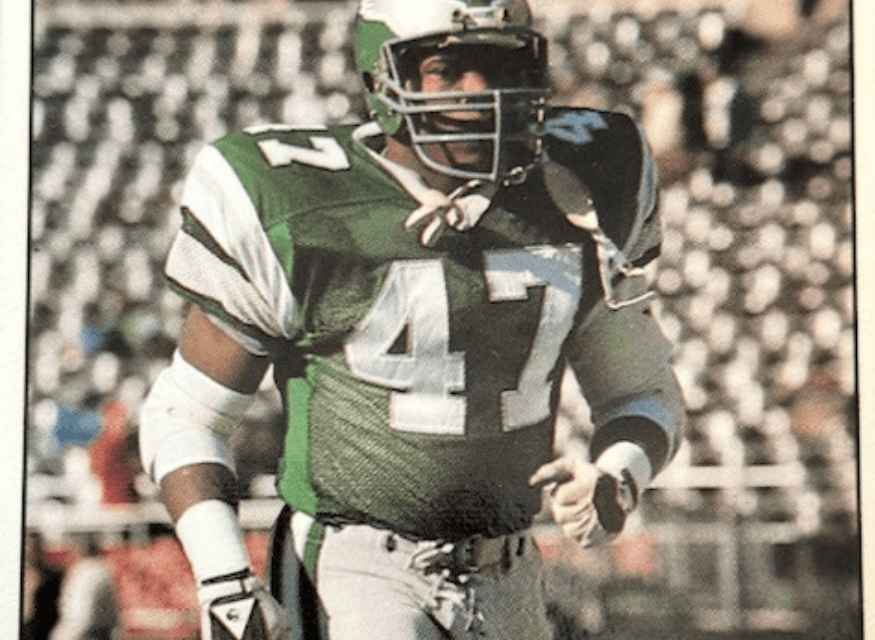
Andre Hardy knows what it feels like to chase something that seems impossible.
Long before becoming a novelist, Hardy was a professional football player. He made it to the NFL and played for the Philadelphia Eagles. Years later, he found himself pursuing another goal and career with similarly insurmountable odds, getting a novel published by a major publishing house.
His debut novel, Tear the City Down, is the result.
When I spoke with Hardy, I wanted to know the through line of these two seemingly different lives. His answer was surprisingly simple.
The discipline required to become a professional athlete wasn't all that different from the discipline required to become a writer.
Both require you to show up when you don't always feel compelled to. Both require you to try. Both require you to fail. Both require you to hear constantly criticism about what you're doing wrong without allowing that to penetrate your mindset.
And eventually, both require you to figure out what Hardy calls "the inner critic."
From the NFL to Writing
Josh Felgoise: When you look at these two versions of yourself, NFL player and now novelist, what connects those experiences for you?
Andre Hardy: They are identical in the sort of engine of what it takes to accomplish something of this magnitude.
The odds of being a professional football player are infinitesimal. And it might be even more difficult to publish with a Big Five house. There are these two almost impossible dreams, and I've done them both.
Where they intersect is the discipline to show up to work every day. And where they intersect is the amount of failure and taking feedback.
Getting notes back from a copy editor is like film study after a game. They're the exact same. The way that you need to comport yourself is also exactly the same.
You can't take things personal. The feedback is only to make you better.
You have to get out of your own way, be able to accept feedback, and then execute on those notes.
You Can't Wait Until You Feel Like Doing It
Josh: Talk to me about that discipline. How do you train yourself to keep showing up when you're trying to accomplish something that not a lot of people can do?"
Hardy: "If you wait until you feel like training, you would never get anything done. Because who feels like waking up every morning at five a.m.?
Over time, you develop this trigger or mechanism where all it takes is for you to get started.
I saw this trainer the other day telling his clients, "If you don't feel like working out, just go to the gym for five minutes. Just put on your shoes and go there for five minutes."
Once you get started, your habit takes over.
You might have thought you were only going to run a mile or be in the gym for 40 minutes, but once you get going, that engine, the thing that drives you, takes over.
For me, it was the willingness to sit down and write even on those days when I didn't feel like it.
The Inner Critic
Josh: You said writers and athletes have to find a way to deal with the inner critic. Why is that so important?
Hardy: If you knew that when you sat down to write that you could be published, but it was going to be an arduous journey, you were going to slip and fall and skin your knee, you were going to be out of breath, and it was going to be the hardest thing you ever did, but in the end you would be published, you would sit down and write every day.
There would be no question.
You would be willing to endure that in order to be published.
The key is, you don't get that first. You get that in the end.
What has to happen in order for you to say, "I'm going to write anyway," is the belief that you can and will accomplish that goal.
The only way to do that is to deal with the inner critic.
I started out on this path with brilliant writers. Writers who should be published. But their inability to deal with the inner critic and to not take feedback personally is what's holding them back.
So How Do You Wrestle With It?
Josh: How do you wrestle your inner critic when it comes up? Because it inevitably will when you're sitting down every day in front of a blank page.
Hardy: Meditation is how I tune my instrument.
Meditation is how I deal with the inner critic.
I have it just like everyone else.
"Andre, you're an imposter."
"You just got lucky with one book."
I'm writing my second book and it's like, "Man, you set the bar really high. Is this going to work? Can you really do it?"
Those things come to me just like everyone else. But I have a tool.
Meditation is my tool to keep my instrument, which is my mind, fine-tuned.
Tuning Your Instrument
Josh: What does that meditation practice actually look like for you? If somebody wants to "tune their instrument," where do they start?
Hardy: The first thing I do is meditate. I sit for at least 15 minutes. Yesterday I was feeling really good, so I sat for 40 minutes.
What that does is slow all of the thoughts down.
It helps me recognize anxiety in my gut before it manifests in my head.
There's always a body sensation before. Your gut knows shit before it happens.
If you can find a way to quiet your mind and be still, you start to notice those things.
"Man, I feel anxiety coming on. Let me pause and manage that."
The meditation works in two ways. It allows me to connect to those body sensations in a way that's really meaningful, and it also gives me the opportunity to convey those on the page because I'm so in tune and familiar with them.
All of that is a result of managing and keeping my instrument fine-tuned through meditation.
Build a Routine That Makes Starting Easier
Josh: What does your actual writing routine look like?
Hardy: We are creatures of routine, whether we know it or not. I think we are at our best when we use routines.
I'm usually up by four-thirty or five a.m., which means the night before I'm also on a sleep routine.
I'll have my coffee. I'll do my meditation. Then I love to see what's going on with contemporary issues and what's happening in the zeitgeist. I'll fool around on YouTube and Instagram, but I literally set a timer and say, "It's 30 minutes. You can do this."
Inevitably something will spur me.
"God, that's interesting."
"That's something I can connect to."
Eventually, the urge to get going just builds and builds and builds.
Then I go to my story.
The More You Do It, The Less It Feels Like Work
Later in our conversation, Hardy told me that writing has become such an important part of his life that he can barely relate to the idea of it being "work" anymore.
He brought up an old clip of Duke Ellington being asked about practicing.
Hardy: He said, "I don't practice. I dream."
That's how I feel.
When other aspiring writers ask about the work of writing, I don't even get it. Because it's not work to me.
It only becomes work when you don't do it.
The more you do it, the more playful it becomes.
Josh: What made you cross that threshold? What turned you from the person who could quit into someone who wants to sit down and write every day?
Hardy: I feel better when I write.
It was nothing more than that.
I do not feel good when I don't write.
I'd rather feel good.
Wrestling the Inner Critic
What I've learned from Hardy is that there probably isn't a point where the inner critic completely disappears.
Hardy has accomplished two things most people will never accomplish. He played professional football. He got his first novel published. And he's working on his second book.
Along the way, the inner thoughts he's wrestled with haven't just magically disappeared.
But he's built a way to respond to them.
Meditate. Build a routine. Start even when you don't feel like starting. Stay consistent. Learn to take feedback without turning it into a verdict on yourself. And keep doing the thing long enough until it eventually starts to feel less like something you're forcing yourself to do and more like something that's simply part of who you are.
Maybe wrestling the inner critic isn't about finally beating it but about learning how to keep going while it's still talking.
More From Andre Hardy, Tear The City Down
More From Guyset
If the inner critic, self-doubt, or overthinking is getting in your way, these might help:
Guyset may earn a commission when you purchase through links on this page.
Read More

How To Stop Caring What Other People Think
How To Stop Caring What Other People Think

How To More Confident Before A First Date
How To More Confident Before A First Date

How to Stop Overthinking When You Really Like Someone
How to Stop Overthinking When You Really Like Someone

How to Turn Rejection Into Something Positive
How to Turn Rejection Into Something Positive